google.com, pub-2032008856654686, DIRECTO, f08c47fec0942fa0

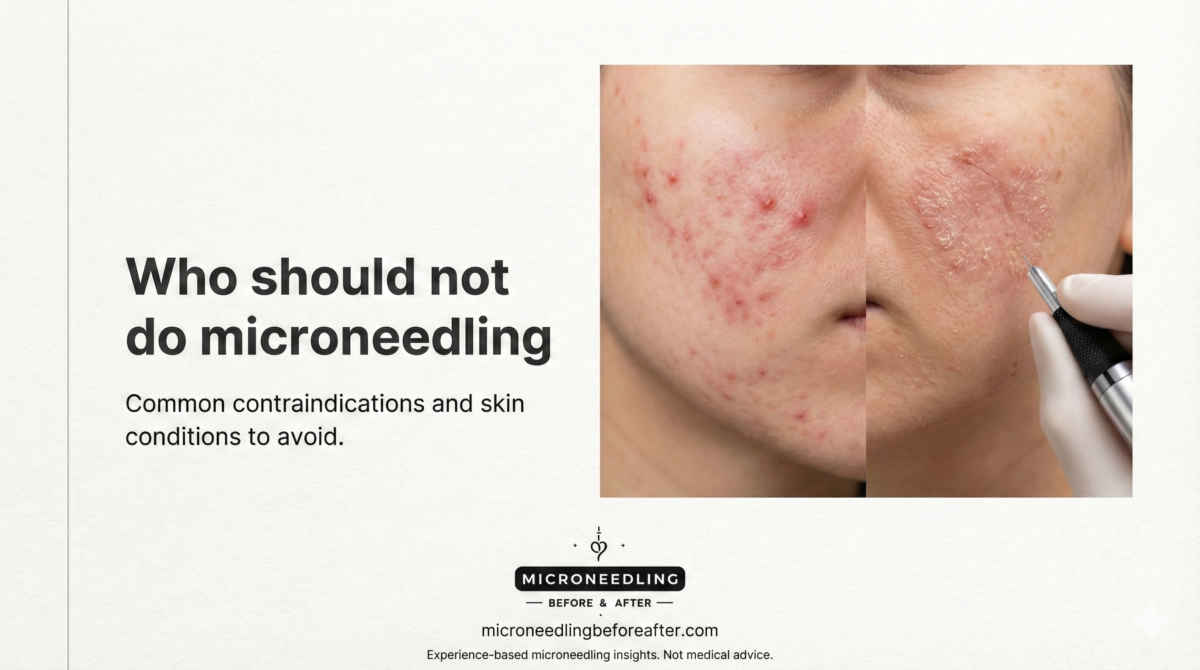
¿Quién no debería someterse a la microaguja?

Quién no debe realizar microagujas: a quién evitar (infecciones, inflamación activa, queloides, isotretinoína, sangrado, compromiso inmunológico) y consejos sobre el momento más seguro para realizarlo ahora.

¿Alguna vez te has preguntado si la microaguja es segura para todos o si hay situaciones en las que no la recomendaría?

¿Quién no debería someterse a la microaguja?

La microaguja es un procedimiento cutáneo popular que suelo comentar con pacientes y amigos. Puede mejorar la textura, las cicatrices, las líneas de expresión y la absorción del producto, pero no es apto para todos. En este artículo, te explicaré los principales grupos de personas que deberían evitar la microaguja, explicaré por qué y ofreceré alternativas seguras o recomendaciones de cuándo aplicarla cuando corresponda. También te explicaré los pasos prácticos que recomiendo antes de someterte a la microaguja para que puedas tomar una decisión informada con tu médico.

Qué hace la microaguja y por qué son importantes las contraindicaciones

La microaguja utiliza agujas diminutas para crear microlesiones controladas en la piel. Estas microlesiones desencadenan una respuesta curativa que estimula la producción de colágeno y elastina. Si bien este proceso puede ser beneficioso, también implica romper deliberadamente la barrera cutánea. Al considerar si una persona es candidata, siempre considero la capacidad de curación, el riesgo de infección, la tendencia a la formación de cicatrices, la medicación y cualquier afección que pueda agravarse por un traumatismo o una cicatrización deficiente.

Seré más específico: algunas afecciones hacen que la microaguja sea riesgosa porque aumenta el riesgo de infección, retrasa la cicatrización o aumenta la probabilidad de cicatrices o pigmentación anormales. En otros casos, las terapias o tratamientos subyacentes pueden interactuar con la microaguja. Me resulta útil desglosar las contraindicaciones por categoría.

Contraindicaciones absolutas y relativas: qué pienso sobre ellas

Clasifico las contraindicaciones en absolutas (no procedería) y relativas (podría proceder solo después de abordar o modificar el problema). Las contraindicaciones absolutas son condiciones o situaciones en las que se debe evitar la microaguja hasta que se resuelva el problema. Las contraindicaciones relativas significan que la microaguja podría ser posible, pero solo después de una evaluación, tratamiento o períodos de espera minuciosos.

A continuación enumeraré condiciones específicas, explicaré las razones y daré mis recomendaciones prácticas.

Infecciones cutáneas activas (bacterianas, fúngicas, virales)

Si tiene una infección cutánea activa en el área de tratamiento (como impétigo, celulitis, tiña activa (infección por hongos) o un brote de herpes simple activo), no realizaría microagujas.

Les explico esto a los pacientes así: la creación de microcanales en la piel infectada permite que los microbios se propaguen más profundamente en el tejido y lleguen al torrente sanguíneo. Esto aumenta el riesgo de una infección grave.

Lo que recomiendo: tratar primero la infección y esperar a que se resuelva por completo. Para el herpes simple (herpes labial), muchos médicos recetan profilaxis antiviral y posponen el tratamiento hasta que se cure o comiencen los antivirales; yo prefiero esperar hasta que no haya una lesión activa y hablar sobre la profilaxis si tiene antecedentes de brotes frecuentes.

Acné inflamatorio activo, brotes de rosácea, psoriasis, eczema.

Si tiene acné inflamatorio activo (lesiones rojas, pustulosas o quísticas), un brote de rosácea activo, placas de psoriasis o dermatitis atópica (eccema) en la zona, le desaconsejaría la microaguja en ese momento.

¿Por qué? La microaguja puede propagar bacterias y mediadores inflamatorios, lo que podría empeorar el acné y causar más irritación o complicaciones posoperatorias. En el caso de la psoriasis o el eccema, el traumatismo podría desencadenar brotes o el fenómeno de Koebner (formación de nuevas lesiones en los puntos de lesión).

Lo que recomiendo: tratar primero la afección activa hasta que esté bajo control. Para el acné, esto podría significar medicamentos tópicos u orales y esperar unos meses si recientemente comenzó una terapia sistémica. Para la rosácea y las dermatosis inflamatorias, es necesario lograr una estabilización durante varias semanas antes de considerar la microaguja.

Historia de queloides o cicatrices hipertróficas

Si tiene antecedentes personales o familiares importantes de formación de queloides o cicatrices hipertróficas, generalmente le aconsejo que no utilice microagujas.

Digo esto porque cualquier procedimiento que dañe intencionalmente la piel puede desencadenar la formación de cicatrices hiperactivas en personas predispuestas. Si bien la microaguja a veces se promociona como un tratamiento para las cicatrices, las personas propensas a los queloides tienen un mayor riesgo de que las cicatrices empeoren.

Recomiendo: evitar la microaguja en zonas con queloides. Si se necesita tratamiento para cicatrices, recomiendo consultar con un dermatólogo o cirujano plástico para opciones más seguras, como inyecciones de esteroides, terapia con silicona u otras modalidades controladas.

Uso sistémico de isotretinoína (Accutane): reciente o continuo

Si está tomando isotretinoína sistémica (comúnmente conocida como Accutane) o la terminó recientemente, adopto un enfoque conservador. Históricamente, muchos médicos recomendaban esperar de 6 a 12 meses después de terminar la isotretinoína antes de realizar microagujas u otros procedimientos de rejuvenecimiento.

¿Por qué? La isotretinoína puede dificultar la cicatrización de heridas y aumentar el riesgo de cicatrices con procedimientos invasivos, aunque la evidencia reciente es contradictoria. Aun así, prefiero ser cauteloso.

Lo que recomiendo: si actualmente toma isotretinoína, evite la microaguja. Si terminó la isotretinoína, consulte con su médico sobre el momento oportuno; normalmente esperaría al menos 6 meses, a veces hasta 12 meses, dependiendo de la dosis y el historial de recuperación.

Trastornos de la coagulación sanguínea y tratamiento anticoagulante

Si tiene un trastorno hemorrágico (por ejemplo, hemofilia) o está tomando anticoagulantes (diluyentes de la sangre) como warfarina, anticoagulantes orales directos o aspirina en dosis altas, la microaguja conlleva un mayor riesgo de sangrado y hematomas.

Hago hincapié en la seguridad: el aumento del sangrado puede complicar el procedimiento, afectar los resultados y prolongar la curación.

Lo que recomiendo: consulte tanto al médico que le recetó el tratamiento como al profesional que realizará el procedimiento. En algunas situaciones, es posible ajustar temporalmente la medicación; en otras, la microaguja podría estar contraindicada. Como mínimo, esperaría un consentimiento informado más amplio y una estrategia para minimizar el sangrado.

Inmunosupresión y tratamiento activo del cáncer

Si está inmunodeprimido (por ejemplo, si toma inmunosupresores sistémicos, productos biológicos, esteroides sistémicos, quimioterapia) o se encuentra bajo terapia activa contra el cáncer, generalmente evitaría la microaguja.

Mi razonamiento es que la inmunosupresión aumenta el riesgo de infección y puede dificultar la cicatrización de heridas. Durante la quimioterapia activa o la terapia inmunosupresora, suelo recomendar posponer los procedimientos cutáneos electivos hasta que mejore la función inmunitaria.

Lo que recomiendo: Consulte con el oncólogo o especialista que lo atiende. Posponga la microaguja electiva hasta que tenga el alta y su sistema inmunitario se haya recuperado.

diabetes no controlada

Si tiene diabetes mal controlada, soy cauteloso con la microaguja porque el control deficiente de la glucosa puede retrasar la curación y aumentar el riesgo de infección.

No quiero correr el riesgo de complicaciones, por lo que prefiero que la enfermedad sistémica esté estable y bien controlada antes de realizar procedimientos electivos en la piel.

Lo que recomiendo: lograr un buen control de la glucemia y obtener la aprobación de su médico de atención primaria o endocrinólogo antes del tratamiento.

Cáncer de piel activo o reciente en el área de tratamiento

Si tiene un cáncer de piel activo en el área que desea tratar, o se está recuperando de un tratamiento reciente contra el cáncer de piel, la microaguja no es apropiada hasta que el médico que atiende su cáncer confirme que es seguro.

Siempre priorizo el tratamiento del cáncer. La microaguja podría interferir con la vigilancia y la cicatrización tras la escisión o la radioterapia.

Lo que recomiendo: esperar hasta que su cáncer de piel haya sido tratado y tenga una guía clara de su dermatólogo u oncólogo.

Peeling químico reciente, rejuvenecimiento con láser u otros procedimientos ablativos

Si recientemente se ha sometido a una exfoliación química agresiva, un rejuvenecimiento con láser u otro procedimiento ablativo, le recomiendo esperar hasta que la piel haya sanado por completo antes de realizar la microaguja.

Explico que combinar o espaciar los procedimientos de forma inadecuada puede causar un trauma acumulativo, aumentando las cicatrices y los problemas pigmentarios.

Lo que recomiendo: Consulte el cronograma con el profesional que realizó el procedimiento anterior. Los intervalos típicos varían, pero suelen oscilar entre varias semanas y meses, dependiendo de la intensidad del tratamiento previo.

Embarazo y lactancia materna

Si está embarazada o amamantando, generalmente recomiendo evitar la microaguja como procedimiento electivo.

Mi razonamiento: existe evidencia limitada sobre la seguridad de la microaguja durante el embarazo, y los cambios hormonales relacionados con el embarazo pueden afectar la cicatrización y la pigmentación. Además, los agentes tópicos que a veces se usan con la microaguja (como los retinoides) están contraindicados durante el embarazo.

Lo que recomiendo: posponer la microaguja hasta después del embarazo y la lactancia, o consultar tanto con su obstetra como con su dermatólogo si hay circunstancias especiales.

Rellenos faciales, hilos o implantes recientes

Si recientemente se ha aplicado rellenos dérmicos, hilos tensores u otros implantes en la zona a tratar, el momento oportuno es importante. La microaguja aplicada demasiado cerca de las inyecciones de relleno puede aumentar el riesgo de infección y desplazamiento del producto.

Generalmente recomiendo esperar un tiempo después de la colocación del relleno y tener cuidado cerca de los sitios de relleno.

Lo que recomiendo: para la mayoría de los rellenos de ácido hialurónico, sugiero esperar al menos 2 semanas y, a menudo, más tiempo; algunos profesionales prefieren 4 semanas. Para implantes o hilos permanentes, consulte con el profesional que le atiende sobre el momento más seguro.

Tatuajes y maquillaje permanente

La microaguja aplicada directamente sobre tatuajes o maquillaje permanente puede alterar el pigmento, provocar su migración y aumentar el riesgo de infección.

Generalmente les digo a las personas que eviten la microaguja directamente sobre los tatuajes, a menos que un especialista con experiencia esté planeando el procedimiento por un motivo específico.

Lo que recomiendo: tratar únicamente la piel no tatuada o consultar a un especialista con experiencia en el trabajo con zonas tatuadas.

Alergias conocidas a agentes anestésicos o ingredientes tópicos.

Si tiene una alergia documentada a los anestésicos tópicos o a los ingredientes comúnmente utilizados en los protocolos de cuidados posteriores (como ciertos antisépticos o antibióticos tópicos), lo consideraré una contraindicación hasta que encontremos alternativas.

Siempre pregunto sobre las alergias porque las reacciones durante o después del procedimiento pueden complicar la curación.

Lo que recomiendo: informar sobre todas las alergias y reacciones previas. A menudo podemos elegir productos alternativos, pero esto podría afectar la programación o la decisión de proceder.

Infecciones virales recientes o enfermedades sistémicas

Si actualmente está enfermo con una infección sistémica (por ejemplo, una enfermedad similar a la gripe o COVID-19), pospondría la microaguja hasta que se haya recuperado.

Hago hincapié primero en el descanso y la recuperación; el cuerpo se cura mejor cuando no está luchando contra otra enfermedad activa.

Lo que recomiendo: reprogramar después de una recuperación completa y asegurarse de que no haya fiebre activa ni síntomas sistémicos.

Tabla: Referencia rápida de contraindicaciones comunes

Considero que las tablas son útiles para tomar decisiones clínicas rápidamente. A continuación, se presenta un resumen conciso de las contraindicaciones comunes, su importancia y mis recomendaciones habituales.

Condición/Situación Por qué es una preocupación Mi recomendación práctica
Infección cutánea activa (bacteriana/fúngica/herpética) Riesgo de infección más profunda y propagación Tratar la infección y esperar hasta que se resuelva
Acné inflamatorio activo, rosácea, psoriasis, eczema. Puede empeorar la inflamación o desencadenar lesiones. Controle primero la condición; reevalúe cuando esté estable
Historia de queloides/cicatrización hipertrófica Riesgo de cicatrización anormal Evite la microaguja en zonas propensas; considere alternativas
Isotretinoína sistémica (actual/reciente) Cicatrización deficiente; riesgo de cicatrices Evitar durante la terapia; esperar de 6 a 12 meses después de finalizarla
Terapia anticoagulante / trastornos hemorrágicos Sangrado excesivo, hematomas, hematomas Consulte al médico que prescribe; puede posponer o ajustar los medicamentos.
Inmunosupresión/quimioterapia Cicatrización deficiente, riesgo de infección Posponer hasta la recuperación inmunológica; obtener autorización
diabetes no controlada Mala cicatrización, infección Lograr el control glucémico; obtener autorización médica
Cáncer de piel activo o escisión reciente Interfiere con la atención del cáncer Espere hasta que el especialista lo autorice.
Tratamientos ablativos recientes (láser/peeling) Trauma acumulativo, curación retardada Siga el intervalo recomendado por el médico
Embarazo / lactancia Datos de seguridad limitados; contraindicaciones tópicas Posponer hasta después del embarazo/la lactancia
Rellenos, hilos e implantes recientes Riesgo de infección, desplazamiento del relleno Espere el intervalo recomendado; consulte al médico tratante
Tatuajes/maquillaje permanente Alteración de la pigmentación, infección. Evite el tratamiento directo; consulte a un especialista.
Alergias a agentes tópicos/anestésicos Riesgo de reacción alérgica Utilice alternativas o posponga

Consideraciones especiales: melasma, hiperpigmentación y tipos de piel más oscuros.

Si tienes melasma o pieles más oscuras tipo Fitzpatrick, procedo con precaución. La microaguja puede ser útil para algunos problemas de pigmentación, pero también puede provocar hiperpigmentación postinflamatoria (HPI) si no se realiza correctamente.

Generalmente recomiendo un régimen pretratamiento cuidadoso (que incluye protección solar y agentes tópicos como hidroquinona o ácido tranexámico cuando corresponda) y un tratamiento conservador. En algunos casos, la microaguja combinada con crioterapia o peelings químicos está contraindicada para el melasma.

Recomiendo: consultar con un dermatólogo con experiencia en piel pigmentada, seguir un plan de pretratamiento para estabilizar el melasma y utilizar técnicas conservadoras. Si el melasma está activo o inestable, posponer el tratamiento.

Dispositivos de microagujas para uso doméstico: precaución adicional

Los dermarollers y microagujas para uso doméstico están ampliamente disponibles, pero conllevan riesgos diferentes a los de los tratamientos en consultorio. Me preocupa la esterilización inadecuada, compartir dispositivos, la longitud excesiva de las agujas y el uso agresivo que aumenta el riesgo de infección y cicatrices.

A menudo les digo a las personas que los procedimientos en el consultorio son más seguros debido a los dispositivos de grado médico, la técnica estéril y los proveedores capacitados.

Lo que recomiendo: si estás considerando usarlo en casa, usa dispositivos con agujas cortas (normalmente de 0,25 mm) y mantén una higiene estricta. Sin embargo, para tratamientos más profundos o si tienes alguna de las contraindicaciones mencionadas, consulta con un profesional en lugar de hacerlo tú mismo.

Interacciones medicamentosas y tópicas: qué pregunto antes del tratamiento

Antes de aceptar la microaguja para cualquier persona, reviso los medicamentos y productos tópicos que podrían afectar la seguridad:

  • Isotretinoína sistémica (Accutane): evitar durante el uso y durante el período de espera recomendado después del mismo.
  • Anticoagulantes y antiagregantes plaquetarios: evaluar riesgo de sangrado.
  • Inmunosupresores sistémicos o biológicos: analizar el riesgo y el momento oportuno.
  • Retinoides tópicos y exfoliantes: a menudo se suspenden antes y después del tratamiento para reducir la irritación.
  • Antibióticos o antivirales orales: pueden usarse de manera profiláctica en casos selectos (por ejemplo, antecedentes de herpes labial).

Recomiendo la divulgación completa de los medicamentos y suplementos, incluidos los AINE de venta libre y los suplementos a base de hierbas que afectan el sangrado (como el aceite de pescado, el ginkgo o la vitamina E en dosis altas), para poder asesorar adecuadamente.

Cómo evalúo la candidatura durante una consulta

Cuando alguien me pregunta sobre la microaguja, adopto un enfoque estructurado:

  1. Historial médico: reviso enfermedades sistémicas, medicamentos, estado de embarazo y condiciones autoinmunes.
  2. Historial dermatológico: pregunto sobre antecedentes de herpes labial, acné, queloides, problemas de pigmentación y procedimientos previos.
  3. Examen de la piel: inspecciono el área de tratamiento para detectar lesiones activas, quemaduras solares o irritación.
  4. Expectations: I discuss goals, risks, number of sessions, and realistic outcomes.
  5. Plan: I advise on pre-treatment steps (stop topical retinoids, stabilize disease) and post-care.

I encourage open dialogue because the safest plan depends on individual risk factors.

Alternatives when microneedling is not appropriate

If microneedling is contraindicated, I often suggest safer alternatives depending on the problem you want to treat.

  • Superficial chemical peels or gentle light chemical exfoliation — for mild texture and superficial pigmentation, if appropriate.
  • Microdermabrasion — noninvasive option for skin texture; lower infection risk.
  • Topical medical therapies — retinoids, hydroquinone, tranexamic acid, or prescription creams for pigmentation and texture over time.
  • Injectable options — in select cases, fillers or neuromodulators might address volume loss or lines without resurfacing.
  • Laser or light therapies — though some lasers share similar contraindications, certain nonablative lasers may be considered when microneedling is inappropriate; always evaluate on a case-by-case basis.
  • Scar-specific treatments — for keloids or hypertrophic scars, steroid injections, silicone sheeting, or surgical options with specialized planning.

I always tailor alternatives to the condition and the person’s medical profile.

Safety tips and red flags I use in practice

I give people practical safety advice so they can spot red flags and make informed choices.

  • Choose an experienced, licensed provider. I prefer clinicians with medical training or supervised settings.
  • Verify the clinic’s sterilization protocols and that single-use, disposable needles are used for in-office treatments.
  • Be wary of aggressive pricing or offers that encourage skipping pre-procedure medical review.
  • If you notice unusual pain, spreading redness, fever, or pus after treatment, seek urgent medical attention.
  • Avoid sun exposure and tanning immediately before and after microneedling to reduce pigmentary complications.
  • Follow post-care instructions for cleansers, ointments, and sunscreens strictly—these influence healing and outcomes.

If anything feels “off” during or after the procedure, I urge people to contact their provider promptly.

Frequently asked questions I get from patients

I often get a set of predictable questions. Here are my typical answers:

  • Can I get microneedling if I have acne scars? Yes, in many cases microneedling is effective for atrophic acne scars, but not during active inflammatory acne.
  • If I’m prone to cold sores, can I still have microneedling? Possibly. I usually recommend antiviral prophylaxis and ensure no active lesions are present.
  • Is microneedling safe on all skin tones? Microneedling is generally safer than many lasers for darker skin tones but carries PIH risk; careful technique and pre/post treatments are important.
  • Can teenagers have microneedling? I’m cautious with younger skin; if someone is a teen, I assess the underlying issue and often prefer conservative treatments first.
  • How many sessions are needed? That depends on the concern; 3–6 sessions spaced weeks apart is common for many indications, but I always tailor the plan.

Post-procedure considerations and when to contact a clinician

After microneedling, normal responses include redness, mild swelling, and pinpoint bleeding or bruising that resolves in days. Use gentle cleansers, moisturizers, and sunscreens as instructed.

Contact your clinician if you experience increasing pain, swelling beyond a few days, spreading redness, fever, pus, or if you notice signs of an allergic reaction such as hives or difficulty breathing.

I tell people that prompt attention reduces the risk of complications becoming serious.

Final checklist I use before recommending microneedling

When I’m thinking about whether microneedling is appropriate, I mentally run through this checklist:

  • Is the skin free of active infection or inflammatory disease in the area?
  • Are there any systemic illnesses or medications that impair healing?
  • Is pregnancy or breastfeeding a factor?
  • Is there a history of abnormal scarring or bleeding disorders?
  • Have recent procedures or treatments been completed in a safe timeframe?
  • Is the patient informed about alternatives, risks, and realistic expectations?

If any items raise concern, I postpone or adapt the plan, or I refer to a specialist.

Conclusión

Microneedling can be an effective tool for many skin concerns, but it is not a one-size-fits-all solution. I always evaluate the whole person—medical history, current medications, skin condition, and expectations—before recommending microneedling. There are clear scenarios where I would not perform microneedling or where I would require specific precautions: active infections, uncontrolled systemic conditions, recent isotretinoin use, immunosuppression, pregnancy, and a history of keloids, among others.

If you’re considering microneedling, I encourage you to have a candid conversation with a qualified provider, disclose your full medical history, and follow pre- and post-care instructions closely. When microneedling is avoided for safety reasons, there are typically safer alternatives that can still help you reach your goals without putting your health at risk.

If you want, I can help you think through a specific medical history or concern to determine whether microneedling might be appropriate for you and what timing or alternatives I would suggest.

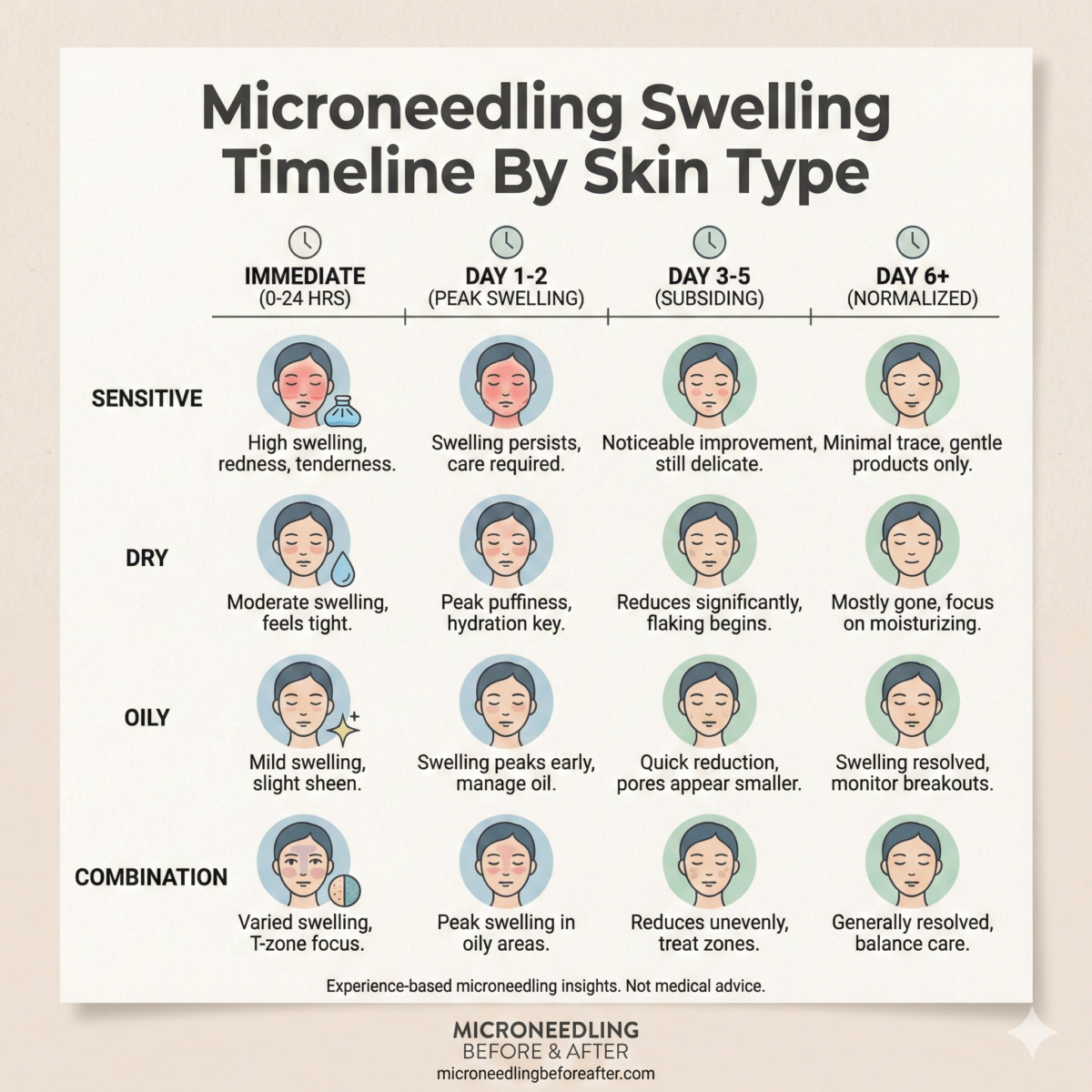
Cronología de la inflamación con microagujas según el tipo de piel

Microneedling swelling timeline by skin type: learn how long puffiness lasts, what affects recovery, and practical aftercare tips for each skin type.

How long will my face remain swollen after microneedling, and how does my skin type influence that timeline?

Cronología de la inflamación con microagujas según el tipo de piel

I will explain how microneedling typically causes swelling, why the response varies across skin types, and what realistic timelines look like. I will also provide practical management strategies so you can plan treatments and expectations appropriately.

Why swelling occurs after microneedling

I recognize that microneedling purposefully creates controlled micro-injuries in the skin to stimulate collagen and elastin production. Swelling is a normal inflammatory response as fluid and immune cells rush to the treated areas to begin repair, and the degree of swelling depends on several physiologic and treatment variables.

How I classify skin types for swelling expectations

I use common dermatologic and cosmetic categories: normal, dry, oily, combination, sensitive, acne-prone, rosacea-prone, darker (higher Fitzpatrick) skin tones, fair/thin/aging skin, and those with inflammatory skin conditions like eczema or psoriasis. I find this classification practical for anticipating swelling patterns and advising aftercare.

General factors that influence swelling

I will outline the main variables that change how much and how long swelling will last so you can understand why two people may experience different timelines after the same procedure.

  • Treatment depth and device: Professional devices with needles at 1.5 mm or deeper and radiofrequency-microneedling cause more swelling than shallow at-home devices.
  • Number of passes and treatment intensity: More passes and firmer pressure increase swelling.
  • Anatomic area treated: Periorbital, lip, and forehead regions often swell more due to thinner skin and loose subcutaneous tissues.
  • Pre-existing inflammation and skin conditions: Rosacea and acne can amplify swelling.
  • Systemic factors: Medications (blood thinners), recent alcohol, salt intake, sleep, and hydration influence fluid retention.
  • Technique and topical anesthesia: Use of topical anesthetics, whether vasoconstrictors were used, and post-treatment cooling alter swelling onset and duration.

Typical swelling timeline stages

I find it useful to conceptually divide the healing into stages so patients can track progress and know what to expect at each interval.

Stage Periodo de tiempo Typical signs
Inmediato 0–6 hours Erythema, pinpoint bleeding, initial puffiness
Acute 6–72 hours Peak swelling typically within 24–48 hours, warmth, tenderness
Early recovery 3–7 días Redness decreases, swelling subsides substantially, skin tightness
Late recovery 1–4 weeks Residual erythema resolves, collagen remodeling begins
Full recovery 4–12 weeks Visual improvements mature, minimal swelling or none

I include this table to make the overall pattern easier to understand and to give a frame of reference for more specific skin-type timelines.

Swelling timeline by skin type — summary table

I provide a compact comparison so you can quickly scan expectations for your skin type. These are general estimates; individual responses vary.

Tipo de piel Typical Peak Swelling Usual Duration of Noticeable Swelling Notas
Normal 24–48 hours 2–5 days Predictable response; rapid recovery in most cases
Dry 24–48 hours 3–7 días May feel tight and slightly longer to exfoliate
Oily 24–72 hours 2–6 days Outlet for sebum is unaffected; inflammation may take slightly variable course
Combinación 24–48 hours 2–6 days T-zone regions may recover differently from cheeks
Sensitive 12–72 hours 4–10 days Heightened inflammatory response; redness and swelling can be prolonged
Acne-prone 24–72 hours 3–10 days Active acne may flare; infections are a risk if contraindications ignored
Rosacea-prone 12–72 hours 5–14 days Marked flushing and swelling possible; proceed cautiously
Fitzpatrick IV–VI (darker skin) 24–72 hours 3–10 days Swelling similar or slightly prolonged; risk of PIH requires cautious aftercare
Fair/thin/aging skin 12–48 hours 2–5 days Thinner skin may bruise or swell more readily
Eczema/Psoriasis 12–72 hours 5–14 days or longer Flare risk; must be managed with dermatologist input

I encourage using the table as a starting point rather than a definitive timeline for every individual case.

Piel normal

I consider “normal” skin to have a balanced sebum production and no chronic inflammatory conditions. I typically tell patients with this skin type to expect predictable inflammatory responses.

  • Peak swelling: 24–48 hours
  • Noticeable swelling: 2–5 days
  • Management tips: Gentle cooling and a basic barrier-restoring moisturizer help the skin recover quickly. I advise avoiding harsh actives for the first 72 hours.

Piel seca

I recognize that dry skin often has a compromised barrier and reduced natural oils, which can make it feel tighter and more sensitive after treatment.

  • Peak swelling: 24–48 hours
  • Noticeable swelling: 3–7 days
  • Key considerations: I recommend using occlusive emollients and humectants (e.g., hyaluronic acid followed by a barrier cream) to reduce tightness and promote comfort. Avoid alcohol-based toners or astringents post-treatment.

Piel grasa

I find that oily skin produces a relatively similar swelling response but may handle irritation differently due to thicker sebaceous activity.

  • Peak swelling: 24–72 hours
  • Noticeable swelling: 2–6 days
  • Key considerations: I recommend light, non-comedogenic hydrating products and avoid heavy oil-based creams that can trap heat or bacteria. Monitor for acneiform reactions if active acne is present.

Piel mixta

I explain that combination skin may experience mixed timelines because different facial zones heal at different rates.

  • Peak swelling: 24–48 hours
  • Noticeable swelling: 2–6 days
  • Key considerations: I suggest zone-based aftercare: richer emollients on cheeks if dry, lighter gels on the T-zone if oily. This balances hydration without increasing irritation.

Piel sensible

I note that sensitive skin can have amplified inflammatory responses to injury and topical agents, which makes swelling and redness potentially more pronounced and prolonged.

  • Peak swelling: 12–72 hours
  • Noticeable swelling: 4–10 days
  • Key considerations: I advise patch testing, using minimal passes during treatment, and employing anti-inflammatory soothing agents like topical niacinamide or centella asiatica after professional approval. I often recommend consulting a dermatologist to tailor settings.

Acne-prone skin

I discuss that acne-prone skin presents a special challenge because microneedling can transiently spread bacteria if performed over active pustules and may exacerbate inflammation if not properly selected.

  • Peak swelling: 24–72 hours
  • Noticeable swelling: 3–10 days
  • Key considerations: I generally avoid treating active inflamed acne with microneedling. If treating acne-scarring rather than active lesions, strict antiseptic technique and appropriate topical antimicrobials may be used. I monitor for signs of infection.

Rosacea-prone skin

I emphasize caution for rosacea because capillary fragility and neurovascular hyperreactivity can result in extended flushing and swelling.

  • Peak swelling: 12–72 hours
  • Noticeable swelling: 5–14 days
  • Key considerations: I recommend conservative needle depths, pre- and post-treatment anti-inflammatory regimens (per dermatologist guidance), and consideration of alternative modalities if rosacea is active. I advise clear informed consent about the risk of extended erythema.

Fitzpatrick IV–VI (darker skin tones)

I explain that darker skin tones do not necessarily experience more swelling, but there is a heightened concern for post-inflammatory hyperpigmentation (PIH) if inflammation is prolonged.

  • Peak swelling: 24–72 hours
  • Noticeable swelling: 3–10 days
  • Key considerations: I suggest pre-treatment optimization (retinoid tapering, skin-lightening cosmeceuticals if indicated) and cautious post-treatment management to limit inflammation and potential PIH. I recommend sunscreen and avoidance of heat/inflammation.

Fair, thin, or aging skin

I note that thinner or aged skin may bruise or show edema more visibly, and the response can be quicker to occur because the dermis is less robust.

  • Peak swelling: 12–48 hours
  • Noticeable swelling: 2–5 days
  • Key considerations: I favor lighter settings and a conservative approach. I instruct using gentle moisturizers and short, targeted treatments to prevent prolonged downtime.

Eczema or psoriasis

I stress that inflammatory skin disorders such as eczema or psoriasis require individualized planning because microneedling can potentially trigger flares.

  • Peak swelling: 12–72 hours
  • Noticeable swelling: 5–14 days or longer
  • Key considerations: I typically coordinate with a treating dermatologist. If disease is controlled, limited superficial microneedling may be considered; if active, I recommend postponing. I advise close post-procedure monitoring for flare-ups.

Deep professional vs at-home microneedling — swelling differences

I compare professional in-office treatments with at-home devices to clarify expectations.

  • Professional (0.75–3.0 mm and RF-microneedling): I explain these produce greater and longer swelling, often peaking at 24–48 hours and resolving over several days to two weeks depending on depth.
  • Medical-grade RF-microneedling: I note this induces thermal injury in addition to microchannels, which can extend swelling and erythema beyond what needle-only devices cause.
  • At-home dermarollers (0.2–0.5 mm): I state these cause minimal swelling, generally resolving within 24 hours or less, and primarily stimulate superficial exfoliation rather than significant collagen remodeling.

Immediate post-treatment care (0–24 hours)

I provide a stepwise list of actions that I recommend for the first day to minimize swelling and discomfort.

  • Cooling: Apply clean cool compresses for short intervals (10–15 minutes on, 10–15 minutes off). Avoid prolonged cold that can cause vasoconstriction issues.
  • Cleansing: Use a gentle, non-irritating cleanser to remove blood or lymphatic fluid.
  • Topicals: I advise avoiding active topicals (retinoids, acids, potent vitamin C) and opting for bland, sterile hydrating serums or medical-grade hyaluronic acid if recommended.
  • Positioning: Sleep with your head elevated the first night to reduce facial edema.
  • Avoid: I caution against alcohol, NSAIDs (I ask patients to consult their provider if they are on prescribed anticoagulants), strenuous exercise, heat exposure, and hot showers for 24–48 hours.

First 48–72 hours — peak management

I outline what to expect and how to manage the typical peak swelling window.

  • Expectation: I tell patients that swelling most often peaks within 24–48 hours but can remain elevated into day three for some skin types or deeper treatments.
  • Anti-inflammatories: I sometimes recommend oral antihistamines or short courses of NSAIDs for discomfort if appropriate and approved by the provider. I avoid routine steroid use unless prescribed.
  • Hydration and barrier repair: I encourage continued use of gentle moisturizers, occlusive creams at night, and avoidance of potential irritants.
  • Sun protection: I stress strict UV avoidance and use of physical sunscreens when outdoors.

Days 3–7 — early recovery

I describe the trajectory of swelling and how to modify care as the inflammation subsides.

  • Clinical course: I expect significant reduction in swelling by day 3–5 for most skin types, with residual redness and slight edema possible up to a week.
  • Exfoliation: I advise against mechanical exfoliation and strong chemical peels until the skin barrier is fully restored.
  • Makeup: I typically allow mineral or specially formulated cover cosmetics after 48–72 hours if there is no open bleeding or crusting, but I recommend patch testing.

Weeks 2–4 and beyond — remodeling phase

I explain the longer-term healing process where swelling has resolved but tissue remodeling continues.

  • Clinical course: By 2–4 weeks most patients show minimal swelling; improvements in texture/pore size continue to emerge over 8–12 weeks as collagen remodels.
  • Return to routine: I allow resumption of retinoids and active skincare per a staged plan after 1–3 weeks depending on skin’s recovery.
  • Follow-up treatments: I discuss spacing treatments (commonly 4–6 weeks for collagen induction) and consider conservative approaches for sensitive or reactive skin types.

Practical table: Do’s and don’ts by timeframe

I include this table to provide concise guidance for common post-procedure questions.

Periodo de tiempo Hacer No
0–24 hours Cool intermittently, cleanse gently, use sterile hydrating products Exercise, sauna, hot showers
24–72 hours Continue hydration, elevate head while sleeping, protect from sun Apply active acids, retinoids, heavy makeup on open areas
3–7 días Gradually reintroduce gentle skincare, monitor for infection Aggressive exfoliation or facial waxing
1–4 weeks Reintroduce most actives gradually if tolerated Skip sunscreen or ignore prolonged redness

I use this concise reference to reduce confusion and support safer recovery.

When to seek medical attention

I want to be clear about warning signs that require prompt evaluation.

  • Excessive swelling beyond expected timeline: If swelling continues to worsen after 72 hours or becomes asymmetric and painful.
  • Signs of infection: Increasing pain, warmth, spreading erythema, purulent drainage, or fever.
  • Allergic reactions: Rapid, severe swelling, hives, difficulty breathing — seek emergency care.
  • Prolonged, worsening hyperpigmentation or keloid formation concerns: Seek dermatologic follow-up.

I recommend contacting the treating clinician for any unexpected course.

Preventive strategies and pre-treatment optimization

I advise several steps to reduce the risk of severe swelling and complications before microneedling.

  • Medical history review: I request disclosure of isotretinoin use, anticoagulants, active infections, and inflammatory conditions.
  • Medication timing: I typically ask patients to avoid NSAIDs and high-dose vitamin E pre-procedure only as instructed, and to confirm isotretinoin cessation per dermatologic guidance.
  • Skin preparation: I recommend pre-treating active inflammatory conditions and optimizing barrier function with hydration and, in some cases, topical anti-inflammatories.
  • Conservative settings: For sensitive or high-risk skin types, I favor shallower needle depths and fewer passes.

I find that thoughtful pre-procedure planning reduces downtime and adverse outcomes.

Products and ingredients I recommend or avoid after microneedling

I give practical product guidance that I use when advising patients.

  • Recommend immediately: Sterile saline, gentle hyaluronic acid serums, petroleum-based or ceramide-rich barrier creams, and physical sunscreens once healed.
  • Use with caution: Niacinamide and centella asiatica can be soothing but should be introduced conservatively.
  • Avoid for first 48–72 hours: Retinoids, alpha/beta hydroxy acids, ascorbic acid in high concentration, benzoyl peroxide, and alcohol-based toners.
  • Antimicrobials: I consider topical antiseptics if indicated, but routine antibiotic creams are not always recommended unless there is a clear infection risk.

I emphasize individualized recommendations based on treatment intensity and skin type.

Managing swelling for specific concerns

I offer tailored strategies for some of the more challenging skin types.

  • Rosacea-prone: I recommend pre-treatment control measures (topical or oral therapies) and post-treatment anti-inflammatories per dermatologic direction.
  • Darker skin tones: I stress aggressive sun protection and consider topical lightening agents only after adequate healing to minimize PIH.
  • Acne-prone: I avoid treating over active lesions and ensure antiseptic technique if scars are the target.

I adapt my approach to reduce complications and optimize outcomes for these groups.

Practical lifestyle considerations

I suggest practical behavioral adjustments that help minimize swelling and promote efficient healing.

  • Sleep: I encourage sleeping elevated the first 1–3 nights.
  • Diet: I recommend reducing salt and alcohol intake immediately before and after the treatment to limit edema.
  • Activity: I advise avoiding high-intensity workouts, hot yoga, and heavy sweating for at least 48–72 hours.
  • Travel: If you travel by air immediately after treatment, I advise extra cooling and hydration due to cabin pressure and dehydration effects.

I include these recommendations because modest lifestyle changes can materially affect recovery.

Repeat treatments and cumulative swelling

I explain how swelling may change with subsequent sessions.

  • Cumulative effect: I note that repeated treatments spaced properly may produce less acute swelling as the skin adapts, but deeper or more aggressive sessions can reset the inflammatory response.
  • Spacing: I generally recommend waiting 4–6 weeks between collagen induction sessions for facial treatments so swelling has fully resolved and remodeling is underway.
  • Record-keeping: I advise tracking reactions after each session so settings can be modified if swelling was excessive in prior treatments.

I stress cautious progression to optimize long-term results without unnecessary downtime.

Checklist for post-microneedling care

I provide a short checklist I often give patients to simplify compliance.

  • Cool with clean compresses for short intervals.
  • Keep treated area clean; use gentle cleanser.
  • Apply sterile hydrating serum and barrier cream at night.
  • Avoid active ingredients for at least 72 hours.
  • Use head elevation for sleep first night.
  • Avoid strenuous exercise and heat sources for 48–72 hours.
  • Protect from sun and apply SPF after epidermal healing.
  • Contact provider for signs of infection or unexpected worsening.

I use this checklist to reduce confusion and increase safety.

Clinical scenarios and examples

I offer a few illustrative examples to help you contextualize timelines.

  • Example 1 — 35-year-old with normal skin receiving 1.5 mm in-office microneedling: I would expect peak swelling at 24–48 hours with substantial improvement by day 4 and near-normal appearance by day 7.
  • Example 2 — 45-year-old with rosacea treated superficially: I would expect significant erythema and swelling peaking within 24 hours and possibly lingering through 10 days; I would plan conservative settings and anti-inflammatory post-care.
  • Example 3 — 28-year-old with darker skin undergoing shallow in-office treatment: I would predict modest swelling for 48–72 hours and emphasize strict sun avoidance and inflammatory control to prevent PIH.

I use case examples to make abstract timelines more concrete.

Final considerations and takeaways

I want to leave you with clear, actionable guidance that I would follow or recommend professionally.

  • Expect swelling: Swelling is a normal, transient response to microneedling and usually peaks within 24–48 hours for most skin types.
  • Skin-type variability matters: Sensitive, rosacea-prone, and inflammatory-skin types often have longer or stronger swelling responses and may need conservative treatment plans.
  • Management works: Simple measures—cooling, elevation, gentle hydrating products, and sun protection—can substantially reduce both the intensity and the duration of swelling.
  • Safety first: If you have significant dermatologic conditions or are on medications like isotretinoin or anticoagulants, consult a dermatologist before undergoing microneedling.
  • When in doubt, seek care: Infection or severe allergic reactions are rare but require prompt professional attention.

I remain available to help interpret your specific situation or to tailor aftercare plans based on your particular skin type and the exact microneedling procedure you are considering.

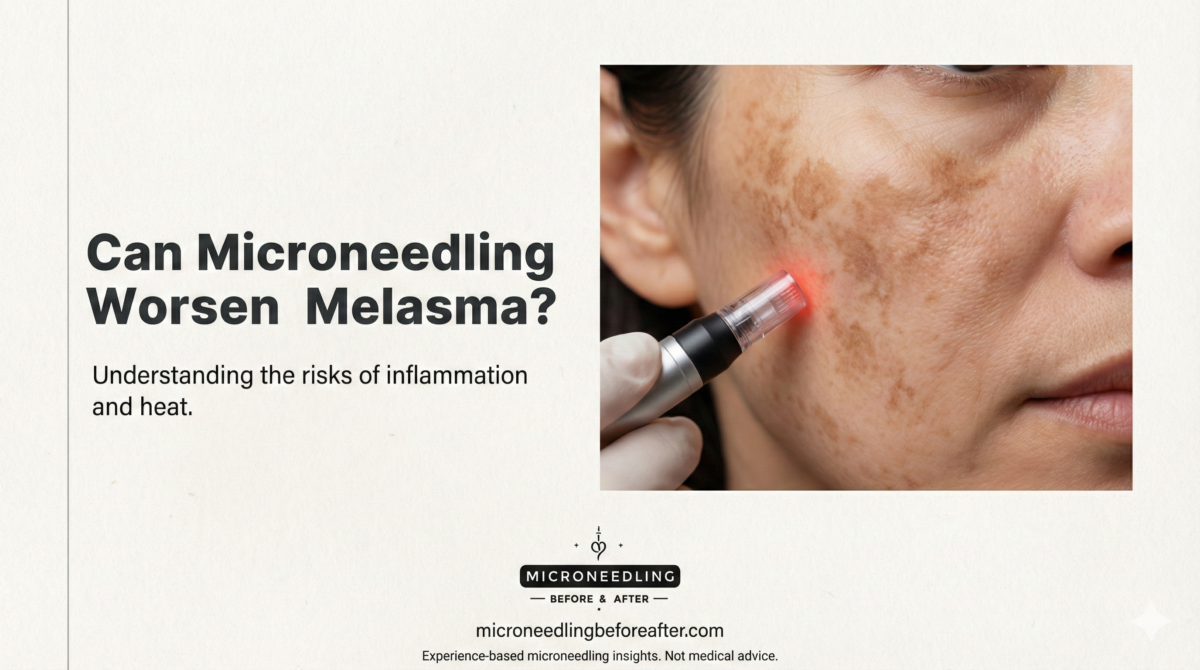
¿Puede la microaguja empeorar el melasma?

Can microneedling worsen melasma? Learn risks, when it may help or harm, key precautions, and safer alternatives to protect skin and minimize PIH. Consult derm.

Have you ever wondered whether microneedling could actually make melasma worse instead of better?

¿Puede la microaguja empeorar el melasma?

I’ll give you a clear, practical look at the question, because I know how frustrating melasma can be and how tempting microneedling sounds as a treatment option. I’ll cover mechanisms, risks, evidence, how I would approach it, and safer alternatives so you can make an informed choice.

Short answer

Yes — microneedling can worsen melasma in some situations, especially if it triggers inflammation, is performed with overly aggressive settings, or isn’t paired with proper pre- and post-procedure care. However, under controlled conditions and combined with the right topical or procedural adjuncts, microneedling may also help certain patients. I always emphasize individualized assessment and conservative technique.

What is melasma?

Melasma is a common chronic skin condition characterized by brown to gray-brown patches, typically on the cheeks, forehead, upper lip, and chin. I think of it as a pigmentary disorder driven by a combination of genetic predisposition, hormonal influences (like pregnancy or oral contraceptives), ultraviolet (UV) exposure, and other triggers such as inflammation or heat.

Melasma isn’t just “too much pigment” — its biology involves pigment-producing cells (melanocytes), the surrounding skin environment (inflammation, blood vessels), and the skin’s response to triggers. Because of that complexity, treatments that only affect one part of the process sometimes fail or can worsen the condition.

¿Qué es la microaguja?

Microneedling is a minimally invasive procedure that uses tiny needles to create controlled micro-injuries in the skin. I describe it as a way to stimulate the skin’s natural repair mechanisms: increased collagen production, enhanced penetration of topical agents, and release of growth factors.

There are different devices and techniques: home-use rollers, professional pens, radiofrequency microneedling (RF), and different needle depths. The intensity and device choice matter a great deal for safety and outcomes.

How microneedling might affect melasma

I like to break this into two opposite potential effects: therapeutic and harmful.

  • Therapeutic potential: Microneedling can enhance delivery of pigment-lightening topical agents and stimulate remodeling of the dermal-epidermal unit. This might help some aspects of melasma, particularly when combined with targeted therapies.
  • Harmful potential: Microneedling causes inflammation. For people prone to post-inflammatory hyperpigmentation (PIH) — especially those with darker skin types — that inflammation can induce more pigment, sometimes worsening melasma rather than improving it.

Post-inflammatory hyperpigmentation (PIH) risk

One of the main concerns I focus on is PIH. Any procedure that injures the skin — even superficially — can produce pigment in susceptible individuals. I’m particularly cautious when treating Fitzpatrick skin types IV–VI because their melanocytes respond more robustly to inflammation.

When microneedling is too aggressive (too deep, too frequent, or done without proper sun protection and topical control), I’ve seen patients develop surrounding hyperpigmentation or an overall darkening of melasma patches.

Depth and technique matter

Needle length, treatment frequency, and device type are key. Superficial microneedling (around 0.25–0.5 mm) primarily improves topical penetration and causes minimal inflammation. Deeper needling (1.0 mm and above) provokes more intense remodeling and a stronger inflammatory response.

I generally recommend starting conservatively, especially for melasma. An experienced provider using a microneedling pen with controlled depth and sterile technique is preferable to home rollers or overaggressive settings.

Evidence from studies and clinical experience

The literature is mixed. I’ll summarize the general themes I’ve seen in studies and clinical reports rather than listing specific trials.

  • Some clinical reports and small studies show improvement in melasma when microneedling is combined with topical agents (for example, tranexamic acid, hydroquinone, or customized serums). Enhanced penetration appears to boost effectiveness.
  • Other reports describe cases of PIH or worsening pigment following microneedling, particularly when performed aggressively or without preconditioning.
  • Radiofrequency microneedling (RF) introduces heat plus needling, which may increase risk of inflammation and PIH in susceptible people, although some protocols claim benefits when paired with appropriate precautions.

Overall, the evidence suggests that microneedling isn’t a one-size-fits-all solution for melasma. It can help in selected situations but can also worsen pigment if not done carefully.

When microneedling may help melasma

I consider microneedling when:

  • The patient has been carefully assessed and other first-line therapies (topical agents, strict sun protection, and medication) have been optimized without sufficient improvement.
  • The practitioner plans to use conservative needle depths and spacing between sessions.
  • Microneedling is being used to enhance penetration of safe and effective topical therapies (for example, tranexamic acid or topical retinoids under supervision).
  • The patient accepts the small but real risk of PIH and follows pre- and post-procedure instructions (sun avoidance, strict sunscreen, anti-inflammatory strategies).

When used judiciously, especially as an adjunct to other evidence-based treatments, microneedling can sometimes produce additional improvement.

When microneedling may worsen melasma

I would avoid or be very cautious with microneedling when:

  • The patient has Fitzpatrick skin type IV–VI and a strong history of PIH.
  • There is active inflammation, a recent sunburn, or recent acne flares in the treatment area.
  • The procedure will use deep needle lengths (>1.0 mm) or aggressive protocols without preconditioning.
  • The patient cannot adhere to strict post-treatment sun protection or appropriate topical management.
  • Microneedling is performed by someone without experience in treating pigmentary disorders.

If I suspect a high risk of PIH, I usually recommend alternative treatments or a test patch before committing to full-face sessions.

Practical table: factors that increase or decrease risk

Factor Effect on Risk of Worsening Melasma Why I Care
Fitzpatrick skin type IV–VI Increases risk More reactive melanocytes → higher PIH risk
Needle depth > 1.0 mm Increases risk Greater inflammation and injury
Frequency (sessions
es_MXSpanish